High-CTR Google Ad Teardowns Across Competitive Niches
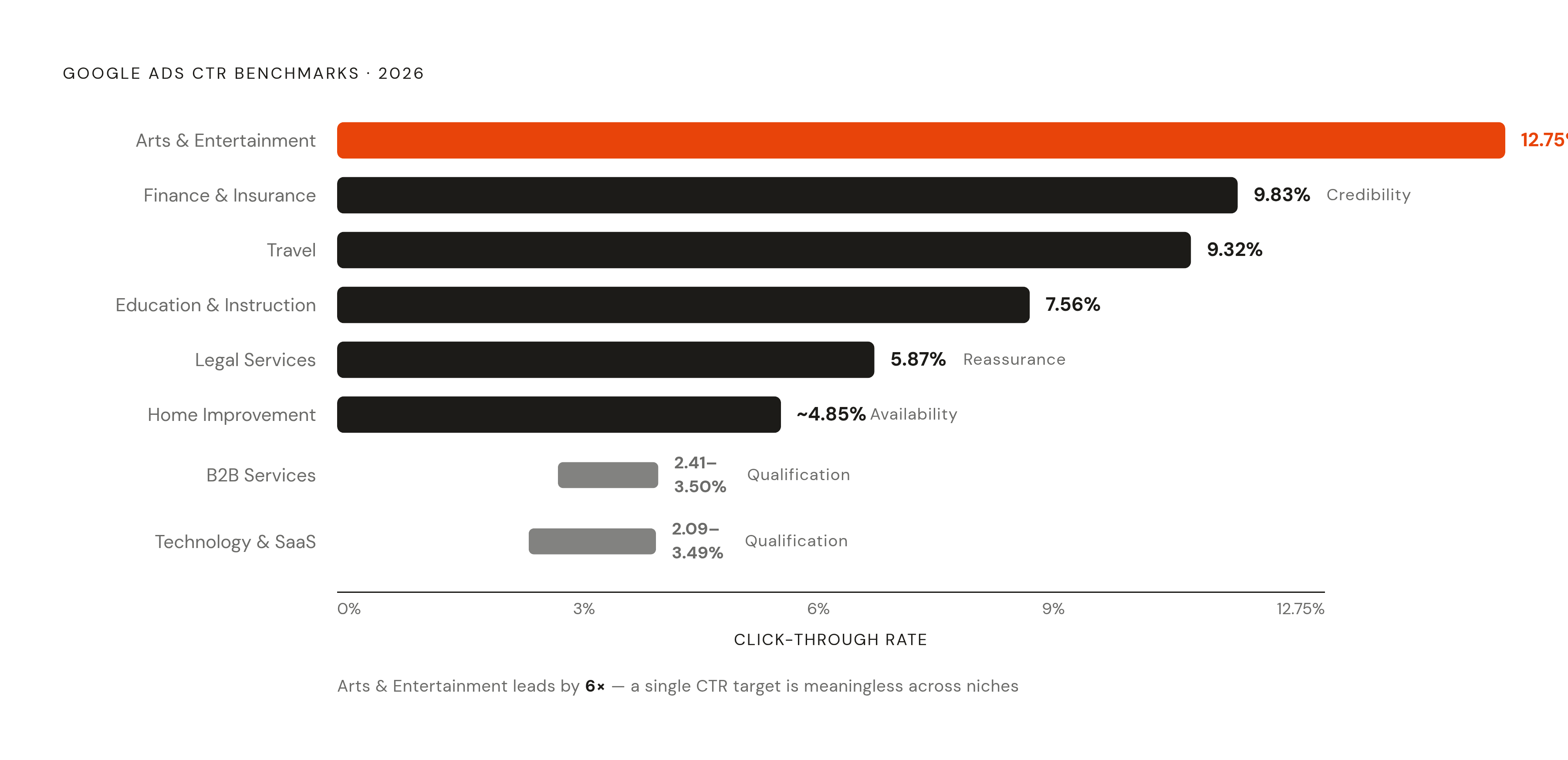
CTR varies sixfold across niches, demanding different copy strategies for each audience intent.

High-CTR Google ad teardowns reveal a clear pattern. Clicks come from repeatable copy and structural decisions, but the right decisions depend on the niche. Entertainment ads show people what they already want, finance ads ease their doubts, and B2B ads help them judge whether an offer fits.
Why CTR varies so dramatically across Google Ads niches — and what that tells us about copy strategy
Trying to match another niche’s CTR benchmark can make good copy look as if it has failed and weak copy look as if it works. The 2026 benchmark breakdown puts Arts & Entertainment at 12.75%, Finance & Insurance at 9.83%, and Travel at 9.32%. Technology & SaaS is between 2.09% and 3.49%, and B2B Services is between 2.41% and 3.50%. That spread comes from differences in how people search as well as how well the ads are written.
The niches differ in intent proximity, meaning how close the searcher already is to taking the next step. An entertainment search can be for something the person wants right now, so they may click as soon as they see the offer. A B2B or legal search often involves evaluation, so the ad has to establish fit before it earns attention. Qualification narrows the audience and can depress CTR even when the copy does its job. A strong entertainment headline and a strong SaaS headline therefore solve different problems, with curiosity driving one and credibility shaping the other.
How the 2026 search landscape changed the conditions ads compete in
Rising CTR in 2026 does not mean copy alone is getting better. AI Max and broad match expansion are finding more relevant query-ad matches, while responsive search ad optimization assembles better headline-description combinations automatically. A teardown that credits every click to the wording misses part of the explanation.
At the same time, rising CTR sits against falling conversion rates in many industries and climbing CPCs. More clicks do not fix the economics if fewer visitors convert and each visit costs more. The promise that attracts attention must also hold up after the click. Understanding these conditions turns a teardown from a description of what an ad looks like into an explanation of what its structure accomplishes.
What makes a structural teardown useful — the four elements worth analyzing in any ad
A useful teardown examines four connected elements, namely headline construction, the offer or proof point, ad extensions, and keyword-to-copy alignment. Headline construction shows where the hook, qualifier, and call to action sit, and whether they match how the audience searches. The offer or proof point supplies the concrete reason to believe, such as a price, guarantee, credential, or time commitment. Extensions give sitelinks, callouts, structured snippets, and call details space to carry information that may decide the click. Keyword-to-copy alignment shows whether the ad uses the query’s language and is just as specific, which affects both relevance and Quality Score.
A clear headline can still leave an important objection unanswered, while a useful extension can supply the missing detail. A useful teardown examines what each part contributes to the searcher’s decision. The niche teardowns that follow apply that same lens to different reasons for clicking.
Arts & Entertainment: why the highest-CTR niche earns clicks with curiosity and immediacy
Arts & Entertainment pairs a 12.75% average CTR with a $1.63 CPC, making it the most click-efficient niche in the dataset. People want the experience now and have few worries about buying it, which helps explain that result. The searcher already wants an experience, so the ad mainly needs to confirm that it offers the right one. That makes the event, experience, or category name a stronger opening than the seller’s brand.
Timing then gives that relevance a deadline. Signals such as “Tonight,” “This Weekend,” and “Limited Seats” fit because the experience genuinely expires, rather than because urgency is a universal copy trick. Structured snippets that list genres, venues, or upcoming dates give people the details they look for as they browse entertainment options. The headline gets the searcher’s attention, and those details help them see whether the offer fits. The offer’s most personally relevant or time-sensitive feature should lead, with entertainment-style urgency reserved for niches where it fits.
Finance & Insurance: earning clicks under high skepticism and high CPC pressure
Finance & Insurance has a 9.83% average CTR. Here, precise claims reduce doubt before the searcher commits to a click. The first headline can carry a rate, coverage amount, or savings figure because a specific claim gives the reader something to assess. Wording such as “rates from X%” has a concrete basis that “great rates” lacks. The placeholder is not the proof, though, and the actual ad needs a specific, verifiable claim.
Description lines then ease doubts about trust with credentials and regulatory signals that apply to the offer. Examples include “Licensed in 50 States,” “A+ BBB Rating,” and “FDIC Insured,” where those claims apply. Under high CPC pressure, that detail helps qualify attention before it becomes paid traffic. Specific keyword-to-copy alignment can also improve relevance and Quality Score, partially offsetting CPC pressure.
Yet the niche’s 2.64% conversion rate shows why the teardown cannot stop at the click. When CTR is strong but conversion is weak, there may be a gap between what the ad specifically promises and what the page that follows offers. It does not prove that every poor conversion comes from that gap. Even so, each headline claim needs something on the landing page that matches it.
Legal Services: writing for the highest-anxiety, highest-CPC click in Google Ads
Legal Services combines a $9.87 average CPC with a 5.87% CTR and a 5.55% conversion rate. At the highest CPC in the dataset, wasted attention is expensive. The searcher may also be frightened, confused, or under time pressure, so excitement is the wrong goal. The headline’s first task is to recognize the situation. A line addressing a car accident speaks more directly to that need than a firm-first label such as “Personal Injury Attorneys.”
A free consultation offer in the headline or first description line answers the concern about what an initial conversation will cost. Location specificity adds another filter because representation depends on place and jurisdiction. “New York Car Accident Lawyer” supplies a detail that “Car Accident Lawyer” leaves unresolved. These choices reduce uncertainty while helping prevent irrelevant clicks.
For time-sensitive queries involving DUI, accident, or eviction, call extensions and call-only ads support the desire to reach a person. On high-CPC keywords such as personal injury, mesothelioma, and car accident, language about case outcomes sets a firm apart more directly than claims about its size. Any such outcome statement needs to be a concrete proof point.
Home Services (Automotive Repair, Home Improvement): converting urgency into the fastest possible click
Home and automotive service searches often need a more immediate answer than legal searches. Searchers need to know whether someone can handle the problem now. Availability language such as “Open Now,” “Same-Day Service,” and “24/7 Emergency” therefore belongs at the front when it matches the service offered. In this setting, availability is the offer.
Price terms then address the fear of an unpleasant surprise. “Free Estimates” and “Upfront Pricing” explain what the searcher can expect before making contact. Sitelinks to services such as AC Repair, Furnace, and Water Heater let a home improvement ad address several needs without overloading the headline. Review counts and rating callouts add a quick trust signal for someone with little time to research. Together, these parts answer availability, cost uncertainty, service fit, and confidence.
Home & Home Improvement carries an $8.33 average CPC and an 8.05% conversion rate. Those figures are for home improvement and would need to be checked before being used for automotive repair, though copy in both puts urgency first. The aim is an efficient path from a specific problem to a relevant service.
B2B Services and Technology/SaaS: making the lowest-CTR niches deliberately selective
B2B Services and Technology/SaaS show why more clicks do not always mean better copy. Their CTR ranges of 2.41%–3.50% and 2.09%–3.49% are the lowest in the dataset, while acquisition costs are among the highest. In that setting, attracting the wrong audience is not a harmless side effect. Copy has to qualify as well as persuade.
The headline therefore benefits from a recognized problem or use case. “Automate Your Sales Outreach” tells a buyer more about the task than “Sales Software.” Qualifiers such as “For Teams of 50+” and “Enterprise Only” narrow that promise to the intended audience. They can reduce CTR while improving conversion rate by discouraging poor-fit clicks. That is the trade the structure is meant to make.
An industry-specific claim such as “Used by 3,000 Marketing Teams” answers whether comparable buyers use the product more directly than a generic review count. The description then has more work to do because the buyer reads further before deciding. AI Overviews add pressure by compressing the organic click pool on informational and comparison queries used in early-stage research. Ads competing there need clear differentiation, with a headline that earns the pause and a description that earns the qualified click.
Education and Real Estate: two niches where the intent type within the category determines the right copy structure
Education and Real Estate expose the limit of a niche-wide template. Each category includes queries with very different distances to a decision. Education & Instruction averages a 7.56% CTR, a 13.14% conversion rate, and a $77.48 cost per lead. Distinguishing who is just browsing from who is serious about applying has to start with the query.
In education, “MBA programs NYC apply now” calls for enrollment-specific language and a direct application step. By contrast, “is an MBA worth it” calls for authority and a content-led next step. The first searcher is considering action, while the second is still weighing the decision. Urgency suited to an applicant does not answer a researcher’s uncertainty.
A buyer searching for “homes for sale in Austin under $500K” needs copy that reflects the location and price constraint. A seller searching for “sell my house fast” brings a different problem and needs a different offer structure. Keyword segmentation is therefore both a copy decision and an account-management task. Putting queries with different intent in one pool gives a blended CTR that hides better results on high-intent terms and can waste money on clicks from people the ad is poorly suited to.
The repeatable patterns that separate high-CTR ads from the rest, across every niche
Entertainment leads with the experience, finance with a credible claim, legal with the searcher’s situation, and urgent services with availability. B2B adds filters, while education and real estate shape the copy around what the searcher wants to do. These approaches answer the same question of what the searcher needs before clicking.
Specificity makes those answers credible. A rate, timeframe, location, or named use case does more work than a superlative any competitor could repeat. Extensions then carry the decision details that do not fit comfortably in the headline. Treating them as decoration leaves part of the ad’s persuasive structure unused. The useful teardown examines how that detail supports the headline.
Performance must finally be read against the right benchmark and the result after the click. A 4% CTR in B2B SaaS may reflect excellent qualification, while a 4% CTR in Arts & Entertainment signals a problem. Conversion rate shows whether people take a useful step after clicking, and landing-page message match helps the page deliver what the ad promised. Testing headline and description combinations through responsive search ads can turn these structural lessons into improvements. The target is not the largest possible click rate, but a repeatable way to earn the right clicks for the niche.